
- Role
- Cesar Delgado · creator & developer
- Status
- Released web edition
- Technology / medium
- Web · Next.js delivery · rule-driven play
- Focus
- Game systems, product scope, rule communication
- 7
- Published modifier cards
- Daily
- A recurring puzzle format
- Web
- The released edition
The project
Wordaloo is a daily word game for players who enjoy a compact puzzle but want a different constraint to reason about each day. A card changes the rules around the word-guessing loop: the challenge is both finding the word and understanding what information can be trusted.
Cesar developed and edited the released web edition. The public product includes a game entry point, instructions and a dedicated reference for its seven current modifier cards. The scope here is the browser release; a native mobile conversion is an extension under consideration.
Scope through a repeatable format
The recurring structure gives the project a clear boundary: one daily puzzle format, with variation concentrated in named rules. A published card reference turns each unusual mechanic into an explicit requirement a player can read before playing.
Make the rule part of the game
Change the information
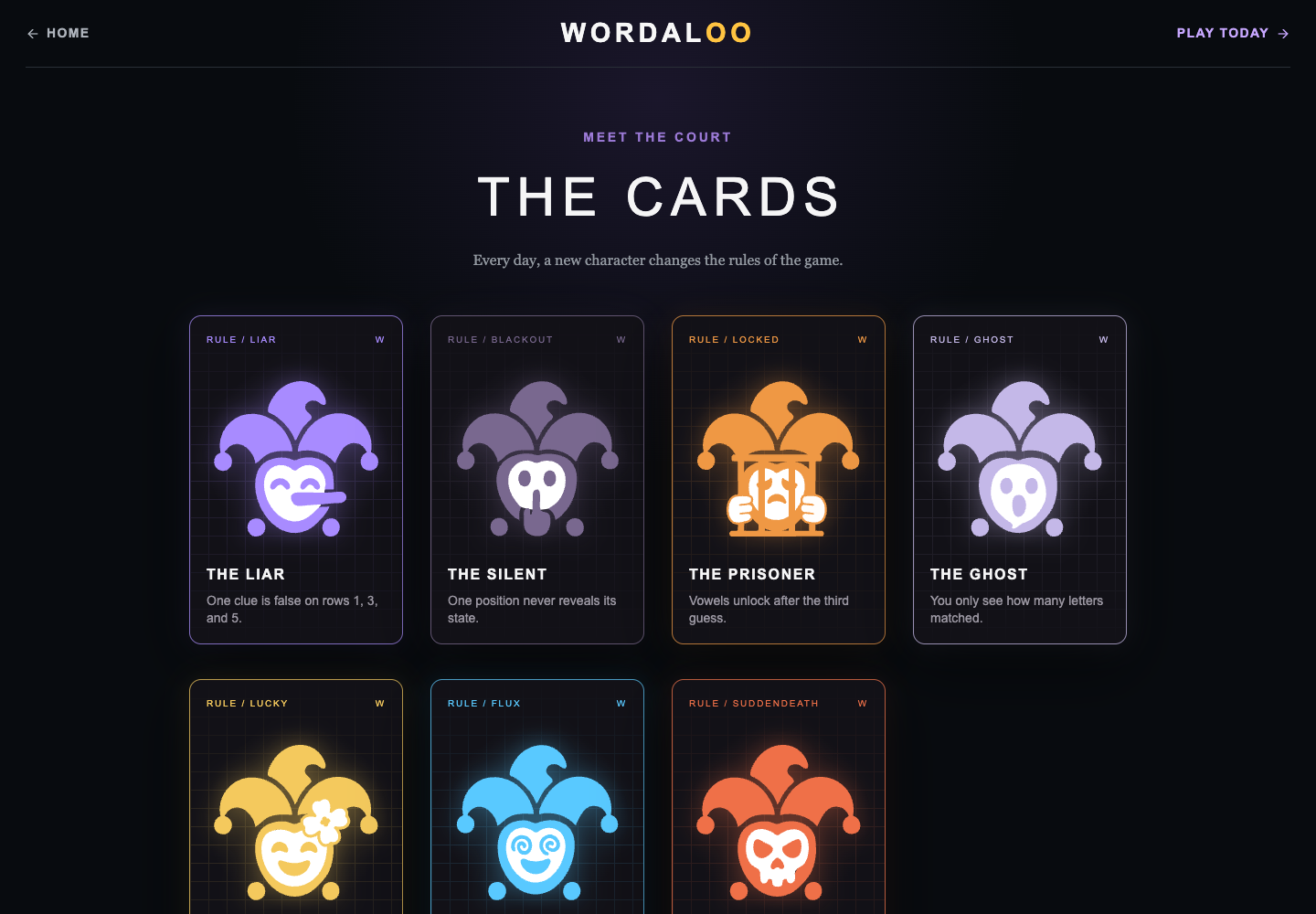
The Silent withholds feedback for one position. The Ghost reports a count of matching letters instead of the usual positional clues. Both alter what the player can infer from a guess.
Change the constraint
The Prisoner keeps vowels unavailable until after guess three. The Hangman gives a shorter guess budget while revealing two letters. Difficulty is expressed through a specific rule, not an unexplained setting.
Give each rule a character
Named cards and a consistent illustrated identity make the modifiers browseable. The separate card gallery gives players a place to resolve ambiguity without relying on the game board alone.
Keep the web release focused
A browser entry point keeps the first edition easy to access. App packaging can be assessed separately from the central question: whether each rule produces an understandable, interesting puzzle.
Rules with different kinds of state
The public site is delivered as Next.js pages with client-side JavaScript and stylesheet assets. Its reference pages separate the stable explanation of each modifier from the daily game entry.
Engineering analysis
The published mechanics affect different parts of a word game. The Liar alters the reliability of feedback on selected rows. The Maverick changes the target once after the third guess. Those two rules cannot be treated as the same visual effect: one changes a clue, while the other changes the answer state.
A useful implementation boundary is therefore the underlying puzzle state versus the information presented to the player. That is an analysis of the requirements visible in the current rules, not a claim about unreviewed internal modules.
- 01Daily puzzleA recurring entry point
- 02ModifierA specific rule contract
- 03Guess & clueInterpret the available evidence
- 04Next decisionAdjust the solving strategy
What the release demonstrates
A publicly inspectable product
The live homepage, instructions and current card reference provide concrete evidence of the released web edition. The product credits Cesar as its developer and editor.
Explicit, reviewable mechanics
Seven published cards make the variation legible: false feedback, hidden feedback, restricted input, counted matches, an opening hint, a target change and a shorter guess budget.
Evidence boundary
This case study describes the public release and its documented mechanics. It does not claim player growth, measured retention, benchmark scores or internal automated-test coverage.
The next questions
A useful next validation step is to review each modifier against the same questions: does a player understand the rule, can the displayed clues be reconciled with it, and does the altered constraint remain fair? These are proposed evaluation criteria, not reported playtest results.
Any mobile edition should preserve the rule explanations, input behavior and daily structure of the web game before expanding its scope.